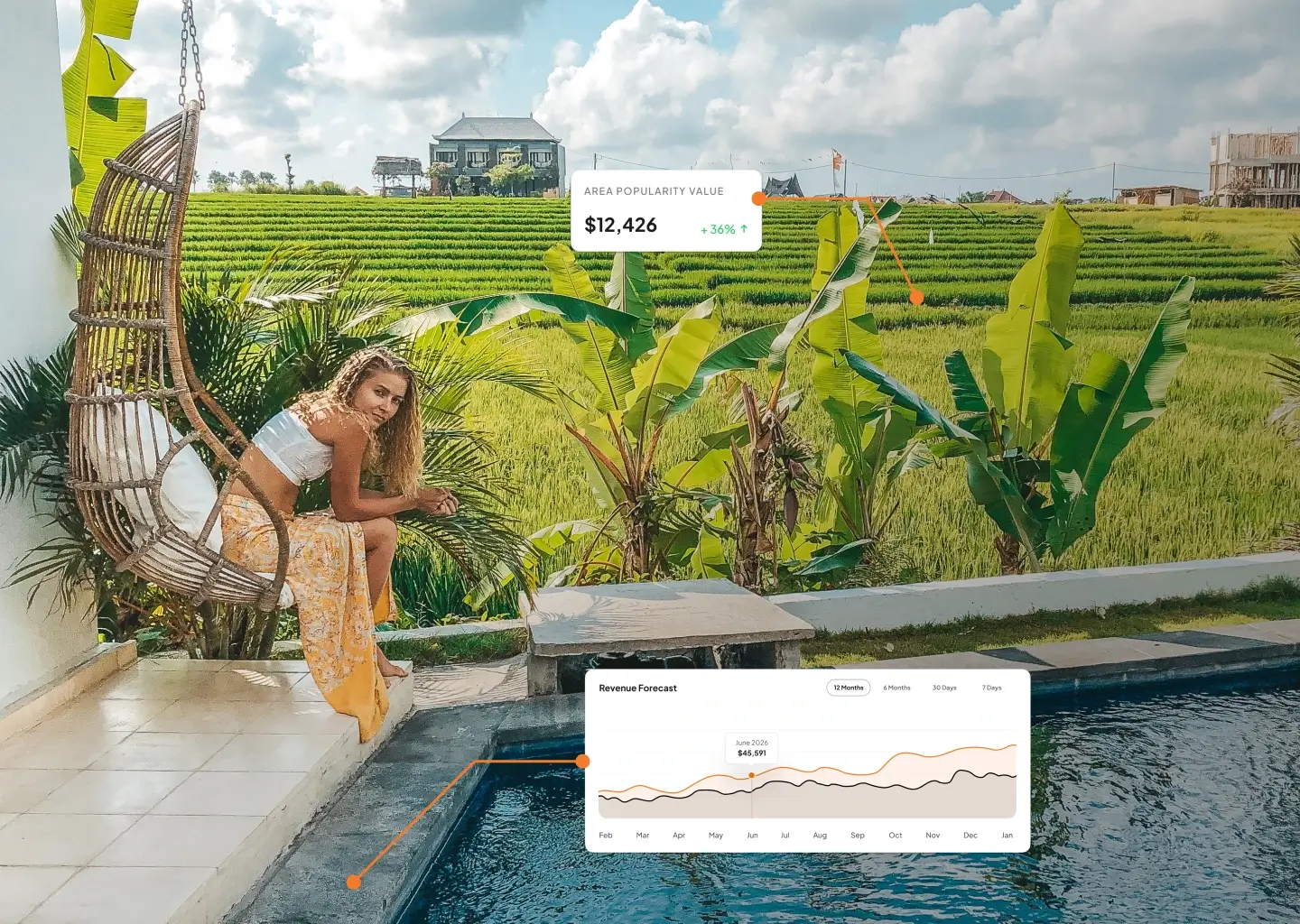
The Basics of Setting Dynamic Prices for Your Bali Villa
What are the key factors to consider when setting dynamic prices for a villa?
When implementing a dynamic pricing strategy for a Bali villa, several key factors must be considered to ensure competitive pricing for vacation rentals:
- Demand and Supply: The fundamental economic principle where higher demand and lower availability drive up prices. This includes monitoring booking pace and current occupancy rates.
- Seasonality: Bali experiences distinct high, shoulder, and low seasons, which heavily influence tourism flow and pricing.
- Competitor Pricing: Constantly monitoring and reacting to the rates of similar properties in the same market to remain competitive.
- Average Daily Rate (ADR) Trends: Tracking historical ADR to understand market performance and set future pricing strategies.
- Location and Touristic Appeal: Villas in popular areas like Canggu, Seminyak, Uluwatu, or Ubud, or those near key attractions, can command higher prices.
- Service Quality and Property Management: High-quality service, professional management, and excellent guest reviews justify premium rates.
- Build Quality and Furnishing: Superior construction, fixtures, and upscale amenities add value and rental potential.
- Global Travel Trends and Economic Conditions: Broader economic factors, inflation, and shifts in traveler preferences can influence the market.
- Local Events and Festivals: Specific events, religious ceremonies (like Nyepi), or public holidays create temporary demand spikes, allowing for higher rates.
- Construction Impact: Nearby construction can negatively affect guest experience and reviews, potentially requiring price adjustments.
How do seasonal trends affect dynamic pricing for villas in Bali?
Bali’s seasonal trends are a primary driver of dynamic pricing for villas:
- High Seasons (June to August & November to December, including Christmas/New Year): These periods, particularly the dry season (April-October), feature minimal rainfall, warm temperatures, and clear skies, attracting a large influx of international visitors. Demand for Bali villa rental rates surges, with nightly rates climbing significantly (often 35-50% higher than low season). Booking well in advance (at least three months) is recommended.
- Shoulder Seasons (April to May & September to October): These months offer generally good weather with fewer crowds. They present a balance of favorable conditions and more affordable prices, with opportunities for deals on accommodation.
- Low Season (January to March, often including November): This coincides with Bali’s wet or rainy season, characterized by higher humidity and more frequent rainfall. Tourist numbers dip, leading to lower demand. Consequently, villa rental rates tend to decrease, sometimes by around 20% compared to high season rates, making it the most affordable time to visit. This season also attracts longer-stay guests like digital nomads.
What tools or software can assist in managing dynamic pricing for vacation rentals?
Several specialized tools and software are available to assist Bali villa owners with their dynamic pricing strategy:
- PriceLabs: A leading platform offering intelligent price recommendations, customizable data-driven smart pricing, and advanced minimum stay intelligence, often used by Airbnb and Vrbo hosts.
- Beyond (formerly Beyond Pricing): Automatically sets optimal prices based on local demand, seasonality, and day of the week, also providing market insights.
- DPGO: An AI-driven tool that analyzes over 200 market data parameters for optimal prices and occupancy rates.
- AirDNA’s Smart Rates: Provides dynamic pricing recommendations to MarketMinder subscribers, leveraging comprehensive short-term rental data.
- Wheelhouse: Offers real-time, AI-driven adjustments by analyzing market trends, demand, and competitor pricing.
- Quibble, Smartness, Hostaway, and Mashvisor: Other platforms that provide dynamic pricing features, often integrated with property management and channel management functionalities.
These tools automate rate adjustments, allowing for efficient revenue management for villas by analyzing vast amounts of data and implementing sophisticated algorithms. When selecting, consider tools that integrate seamlessly with your existing Property Management System (PMS).
Analyzing Market Trends to Inform Your Pricing Strategy
How can property managers stay informed about the Bali rental market?
To effectively inform their dynamic pricing strategy, Bali property managers should continuously monitor the market through:
- Market Analysis Tools: Subscribing to platforms like AirDNA (MarketMinder), PriceLabs Market Dashboards, Mashvisor, Transparent, and Rabbu provides crucial insights. These tools track performance data (occupancy, ADR, revenue) for millions of short-term rentals. This kind of market research for your villa is indispensable.
- Local Property Management Companies: Following insights from local experts and property management companies, like Bukit Vista, who often publish market reports or share their observations on trends and fluctuations in popular investment areas (e.g., Canggu, Seminyak, Ubud).
- Industry Reports and News: Staying updated with general hospitality and tourism reports specific to Bali and Indonesia, including Bali tourism statistics.
- Direct Competitor Monitoring: Regularly checking the pricing and availability of comparable villas in their immediate vicinity across various booking platforms.
How often should market analysis be conducted for effective dynamic pricing?
For truly effective dynamic pricing, market analysis should be an ongoing, continuous process. Dynamic pricing systems are designed to perform real-time analysis, often making adjustments multiple times a day or even hourly.
Property managers should:
- Automated Monitoring: Rely on dynamic pricing software to continuously gather and process market data for real-time rate adjustments.
- Regular Review: Conduct strategic reviews of market dashboards and performance reports (e.g., weekly or monthly) to ensure the automated pricing aligns with overall revenue goals and to make any necessary manual overrides or fine-tuning of the algorithm’s parameters.
- Event-Specific Analysis: Perform targeted analysis ahead of major local events or holidays to ensure optimal pricing is set to capitalize on increased demand.
Implementing a Dynamic Pricing Model for Your Property
What are the steps to implementing dynamic pricing for your Bali villa?
Implementing a dynamic pricing model for your Bali villa involves a structured approach:
- Choose a Dynamic Pricing Software: Select a reputable tool (e.g., PriceLabs, Beyond, DPGO) that fits your budget and operational needs.
- Integrate Systems: Connect the chosen dynamic pricing software with your Property Management System (PMS) and Channel Manager to ensure seamless rate synchronization across all booking platforms (e.g., Airbnb, Vrbo, Booking.com).
- Define Base Prices and Boundaries: Set a realistic base price for your villa and establish minimum and maximum price limits (price floors and ceilings) to prevent rates from dropping too low or soaring too high.
- Configure Custom Rules: Input specific pricing rules based on your property’s unique characteristics, local market knowledge, and preferred strategies (e.g., discounts for longer stays, last-minute deals, premium pricing for specific dates).
- Input Property Data: Provide accurate details about your villa, including number of bedrooms, amenities, location, and quality level, as these influence the algorithm’s recommendations.
- Monitor and Adjust: After initial implementation, closely monitor performance metrics (occupancy, ADR, revenue) and market insights. Make manual adjustments to the pricing recommendations or rules as needed based on observed results and local market nuances.
How can you ensure your pricing strategy adapts to changes in demand?
To ensure your dynamic pricing strategy adapts effectively to changes in demand, a robust and responsive system is key:
- Automated Real-Time Adjustments: Utilize AI-driven software that continuously monitors hundreds of market parameters, including real-time demand signals, competitor pricing, booking pace, and local events, to automatically adjust rates. This is the core of demand-driven pricing for vacation rentals.
- Flexible Rules and Parameters: Configure your dynamic pricing tool with flexible rules that dictate how prices should respond under different demand scenarios (e.g., increase price by X% if occupancy for a future date exceeds Y%, or offer a last-minute discount if unbooked).
- Continuous Learning Algorithms: Many modern dynamic pricing tools use machine learning to learn from past performance and market changes, progressively improving their pricing recommendations.
- Regular Performance Review: Although automated, regularly review your actual occupancy and revenue outcomes against market trends. This oversight allows for manual overrides or recalibration of the pricing parameters to ensure the strategy remains optimal.
What are the pitfalls to avoid when starting with dynamic pricing?
While dynamic pricing offers significant benefits, several pitfalls should be avoided for successful implementation:
- Customer Dissatisfaction: Frequent and drastic price changes can confuse guests, lead to a perceived lack of fairness, generate negative reviews, and reduce repeat bookings. Transparency and value communication are essential. Poor guest experiences directly impact your reputation.
- Data Inaccuracies: Dynamic pricing relies on precise data. Inaccurate or incomplete data (e.g., wrong competitor sets, missing local event info) can lead to suboptimal pricing decisions, resulting in lost revenue or decreased occupancy.
- Over-reliance on Algorithms: Solely trusting algorithms without human oversight or local market expertise can be detrimental. Algorithms might make aggressive adjustments that don’t align with your brand or specific villa unique selling points in the Bali market.
- Failure to Account for Bali-Specific Dynamics: Not recognizing unique local factors like specific cultural events, an oversupply of villas in popular areas (e.g., Canggu), or rapid shifts in traveler preferences can lead to ineffective pricing.
- Inadequate Technology: Using outdated or poorly integrated Property Management Systems (PMS) or Channel Managers can hinder the seamless implementation and management of frequent price changes across platforms, leading to rate parity issues.
- Neglecting Competitor Analysis: Failing to actively monitor and react to competitor pricing can result in uncompetitive rates during low demand or missed revenue opportunities when competitors are sold out.
- Lack of Flexibility: A rigid pricing structure that cannot quickly adapt to unforeseen market changes (e.g., new travel restrictions, economic shifts) will fail to optimize revenue.
Measuring the Success of Your Dynamic Pricing Strategy
What metrics should you track to assess the effectiveness of your pricing?
To assess the effectiveness of your dynamic pricing strategy and ensure competitive pricing for vacation rentals, tracking key metrics is essential for revenue management for villas:
- Revenue Per Available Rental (RevPAR): This is a crucial composite metric that combines both occupancy and average daily rate (ADR). Calculation: Total Revenue / Total Available Nights OR ADR x Occupancy Rate. It provides a holistic view of performance.
- Average Daily Rate (ADR): Measures the average amount earned per booked night. Calculation: Total Revenue / Nights Sold. It reflects your pricing power. Learning how to increase your average daily rate is key.
- Occupancy Rate: The percentage of available nights that are booked. Calculation: Nights Sold / Total Available Nights. Indicates booking success.
- Gross Revenue per Unit / Total Rental Income: The overall income generated from the property, including nightly rates and other fees. This shows the direct financial impact of your dynamic pricing strategy.
- Revenue Growth: Track year-over-year (YOY) and month-over-month (MOM) revenue increases to evaluate the long-term success of the strategy.
- Nights Booked per Unit / Gross Bookings per Unit: These metrics indicate the total volume of bookings and nights secured, showing the property’s market visibility and appeal.
- Average Length of Stay (ALOS): Tracks the average duration of guest stays, important for operational efficiency and cost management.
- Booking Lead Time: How far in advance guests book, which helps in forecasting and adjusting pricing.
- Cancellation Rate: Monitoring this can indicate if pricing or booking conditions are leading to undesirable cancellations.
How do you know if your dynamic pricing strategy is competitive?
Knowing if your dynamic pricing strategy is competitive involves continuous benchmarking and analysis:
- Compare RevPAR, ADR, and Occupancy: Regularly compare your villa’s RevPAR, ADR, and Occupancy Rate against a set of direct competitors (similar properties in the same location and quality segment) and market averages using market intelligence tools (e.g., AirDNA, PriceLabs Market Dashboards).
- Analyze Market Share: Evaluate if your property is capturing a fair share of bookings and revenue within its competitive set.
- Monitor Competitor Behavior: Observe how quickly your competitors are booking up, their pricing fluctuations, and promotional activities. If your villa consistently has lower occupancy or ADR than comparable properties during similar demand periods, your strategy may not be competitive.
- Guest Feedback: Positive reviews often indicate that guests perceive your pricing as fair for the value received, contributing to a competitive reputation.
- Booking Pace: A healthy booking pace for future dates suggests competitive pricing and strong demand.
What adjustments might be necessary if your dynamic pricing is not meeting revenue goals?
If your dynamic pricing strategy is not meeting revenue goals, several adjustments might be necessary:
- Review Data Accuracy and Completeness: Ensure the data feeding your pricing tool (market data, competitor data, property specifics) is accurate and comprehensive. Incorrect inputs lead to flawed outputs.
- Adjust Price Floors and Ceilings: Re-evaluate and modify the minimum and maximum price limits to ensure they are appropriate for current market conditions and allow for sufficient flexibility.
- Refine Custom Rules: Examine and tweak specific pricing rules for discounts (e.g., for longer stays, last-minute bookings) or premiums (e.g., for holidays, events). You might need to be more aggressive with discounts during low season or more conservative with increases during shoulder season.
- Enhance Property Listing and Value Proposition: If occupancy or ADR is low, consider improving your villa’s listing (effective rental listings, professional photos), upgrading amenities, or offering additional services to increase perceived value and justify higher rates. This can address issues like why your Bali villa isn’t getting booked.
- Re-evaluate Competitive Set: Ensure you are comparing your villa to truly comparable properties. You might be under- or over-valuing your property if your competitive set is misaligned.
- Expand Marketing and Distribution: If occupancy is the issue, consider increasing marketing efforts or listing your property on additional booking channels to increase visibility.
- Address Guest Feedback: Analyze guest reviews for recurring issues that might be negatively impacting bookings or perceived value. Addressing these can improve reputation and allow for better competitive pricing.
Best Practices for Maximizing Revenue with Dynamic Pricing
What are some proven dynamic pricing strategies for vacation rentals in Bali?
To effectively maximize revenue with a dynamic pricing strategy for Bali villas, consider these proven approaches:
- Leverage Real-Time Data: Continuously monitor and respond to live demand signals, seasonality, local events, booking lead times, and competitor pricing using advanced dynamic pricing software. This forms the core of demand-driven pricing for vacation rentals.
- Implement Price Floors and Ceilings: Set intelligent boundaries to prevent rates from dropping below profitability or rising to levels that deter bookings, while still allowing the system flexibility.
- Optimize Minimum Stay Requirements: Adjust minimum stay rules dynamically. For instance, enforce longer minimum stays during high-demand periods (peak season, holidays) to capture higher-value bookings, and relax them during low season to fill gaps.
- Strategic Last-Minute Deals: Offer tactical, automated discounts for bookings made closer to the arrival date if occupancy is low, to fill remaining inventory without significantly devaluing the property.
- Event-Based Pricing: Proactively increase rates significantly around major Bali festivals (e.g., Nyepi), international holidays (e.g., Australian school holidays), or local events that are known to drive tourist influx.
- Bundling and Value-Add Services: Augment revenue by offering additional paid services like airport transfers, private chefs, in-villa massages, local tours, or grocery delivery. These extras can justify higher base rates and enhance the guest experience.
- Geo-Targeting and Segmented Pricing: Consider tailoring prices or promotions to specific geographic markets or traveler segments if your booking channels support it, recognizing varying demand from different regions.
How can you balance high occupancy rates with optimal pricing?
Balancing high occupancy rates with optimal pricing is a core goal of revenue management for villas, aimed at achieving the highest possible RevPAR:
- Intelligent Dynamic Pricing Software: Utilize tools that are specifically designed to find the sweet spot between maximizing occupancy and achieving a high Average Daily Rate (ADR). These algorithms work to optimize for RevPAR rather than just occupancy or just high prices.
- Strategic Discounting for Off-Peak/Low Demand: Instead of slashing prices indiscriminately, apply strategic, smaller discounts during low season or for last-minute gaps to attract bookings without significantly eroding profitability. The goal is to fill nights that would otherwise remain vacant.
- Focus on Value Proposition: Ensure your Bali villa consistently offers excellent value for the price, regardless of dynamic adjustments. High-quality amenities, exceptional service, and a well-maintained property justify higher rates and lead to positive guest experiences, which supports competitive pricing.
- Understand Booking Curves: Analyze how far in advance guests typically book. Price strategically, often starting with higher rates for distant future dates and adjusting downwards as the date approaches if demand is slow, or upwards if demand is strong.
- Monitor Cancellation Policies: Ensure your cancellation policies are clear and fair to minimize revenue loss from last-minute cancellations, which can impact both occupancy and revenue.
What role does guest feedback play in adjusting your dynamic pricing strategy?
Guest feedback and online reviews play a critical role in refining and adjusting your dynamic pricing strategy, as they directly impact your villa’s reputation and perceived value:
- Direct Impact on Reputation and Rankings: Positive reviews boost your villa’s online visibility and search rankings on platforms like Airbnb and Vrbo, making it more attractive to potential guests and justifying higher prices. Negative feedback can quickly diminish this. Learning more about how to deliver 5-star guest experiences.
- Identify Value and Justify Pricing: Feedback helps pinpoint what guests value most about your property (e.g., location, specific amenities, service). Highlighting these strengths in your listing and ensuring consistent delivery can justify dynamic rate increases, particularly during peak demand.
- Address Weaknesses and Enhance Perceived Value: Recurring negative feedback about specific issues (e.g., cleanliness, Wi-Fi, noise) signals areas needing improvement. Addressing these issues not only improves guest satisfaction but also enhances the perceived value of your property, allowing you to maintain or increase competitive pricing.
- Influence Pricing Confidence: A consistent stream of excellent reviews provides the confidence to maintain or increase rates during periods of high demand, as guests are more willing to pay a premium for a highly-rated experience. Being a responsive host is part of this.
- Refine Pricing Fairness and Transparency: If guests complain about price fluctuations or perceived unfairness (e.g., seeing prices drop significantly after booking), their feedback can prompt you to refine your communication about how prices are determined or adjust your pricing logic to be more transparent, safeguarding trust and brand image.
By actively monitoring, analyzing, and acting upon guest feedback, Bali villa owners can continuously optimize their dynamic pricing strategy, balancing high occupancy rates with optimal pricing for maximized revenue.